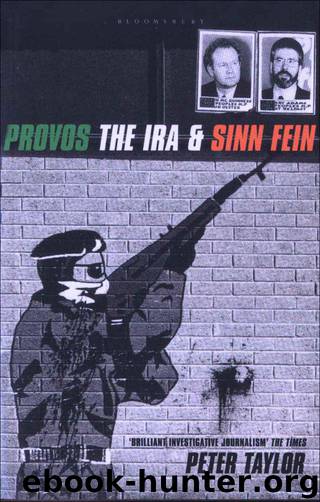
The Provos: The IRA and Sinn Fein by Taylor Peter
Author:Taylor, Peter [Taylor, Peter]
Language: eng
Format: epub
Publisher: Bloomsbury Publishing
Published: 2014-05-28T22:00:00+00:00
Chapter Fifteen
Reassessment
In his New Year message for 1978, Roy Mason declared that ‘the tide has turned against the terrorists and the message for 1978 is one of real hope’.1 He had good reason for saying so. A record number of people had been charged with terrorist offences – 1,308 – and shootings and bombings were dramatically down. The tube of toothpaste was certainly being squeezed. Furthermore, Mason and Newman had stood up to a second loyalist strike in May 1977 and seen off its leader, Ian Paisley. The strike had been called to demand tougher security and a return to majority rule. Paisley had said he would resign if the strike failed.2 He never did. The Queen too, had visited Northern Ireland in her Jubilee year and, by declaring the province safe for Her Majesty, Mason had called the Provisionals’ bluff. Nor were the Government’s successes all one-sided. The RUC’s Regional Crime Squads had virtually smashed the UVF’s structure and brought to justice Lenny Murphy, leader of the notorious loyalist murder gang, the ‘Shankill Butchers’, who had slaughtered Catholics with butchers’ knives. The optimism generated was summed up by the award of the Nobel Peace Prize to Betty Williams and Mairead Corrigan, the leaders of the ‘Peace People’, a grass-roots, cross-community, apolitical movement that had taken to the streets to demand an end to IRA and loyalist violence. Against this background, the problem of Castlereagh and the human-rights issues it raised seemed of little importance.
One of the biggest coups of the year for the security forces North and South was the arrest of the Provisionals’ Chief of Staff, Seamus Twomey, on the run for almost four years. Twomey was picked up in Dublin, having avoided arrest for so long in the North. His freedom of movement in Belfast during the truce, most notably during his appearance at the Easter Commemoration in 1975, had outraged loyalists. Twomey’s run finally came to an end on 3 December 1977 when he was arrested by the Gárdái. On searching the flat where he had stayed in Dun Laoghaire, a few miles from Dublin, police found a document stuffed in a pencil case. Its contents were a dramatic insight into the Provisional IRA after the setback of the truce. The secret document was an IRA GHQ ‘Staff Report’, detailing how the IRA had reorganized to stave off potential defeat. It was almost certainly written much earlier in 1977. The Report was also seen as recognition of how successful British security policy had been.
The three and seven day detention orders are breaking Volunteers, and it is the Republican Army’s fault for not indoctrinating Volunteers with the psychological strength to resist interrogation.
Coupled with this factor, which is contributing to our defeat, we are burdened with an inefficient infrastructure of commands, brigades, battalions and companies. This old system with which Brits and [Special] Branch are familiar has to be changed. We recommend reorganization and remotivation, the building of a new Irish Republican Army.
We must emphasize a return to secrecy and strict discipline.
Download
This site does not store any files on its server. We only index and link to content provided by other sites. Please contact the content providers to delete copyright contents if any and email us, we'll remove relevant links or contents immediately.
| Anthropology | Archaeology |
| Philosophy | Politics & Government |
| Social Sciences | Sociology |
| Women's Studies |
The Secret History by Donna Tartt(19090)
The Social Justice Warrior Handbook by Lisa De Pasquale(12190)
Thirteen Reasons Why by Jay Asher(8912)
This Is How You Lose Her by Junot Diaz(6887)
Weapons of Math Destruction by Cathy O'Neil(6281)
Zero to One by Peter Thiel(5802)
Beartown by Fredrik Backman(5755)
The Myth of the Strong Leader by Archie Brown(5508)
The Fire Next Time by James Baldwin(5447)
How Democracies Die by Steven Levitsky & Daniel Ziblatt(5219)
Promise Me, Dad by Joe Biden(5154)
Stone's Rules by Roger Stone(5088)
A Higher Loyalty: Truth, Lies, and Leadership by James Comey(4964)
100 Deadly Skills by Clint Emerson(4926)
Rise and Kill First by Ronen Bergman(4789)
Secrecy World by Jake Bernstein(4753)
The David Icke Guide to the Global Conspiracy (and how to end it) by David Icke(4720)
The Farm by Tom Rob Smith(4514)
The Doomsday Machine by Daniel Ellsberg(4490)
